In Paris, the same window can be replaced within days in one street, and require two months of review and the approval of an Architecte des Bâtiments de France in the next. The prior declaration of works (déclaration préalable) is the most common procedure, and one of the least understood: people assume it is reserved for large projects, when it covers very ordinary works, and discover too late that the neighbourhood changes everything. Here is how to find your way: when it applies, what heritage districts change, the real timelines, the contents of the file, and how we support our clients through it.
When is a prior declaration required?
The basic rule comes down to one idea: as soon as works change the outward appearance of a building, or its use, a planning authorisation is required. For modest works, it is the prior declaration that applies, rather than a building permit.
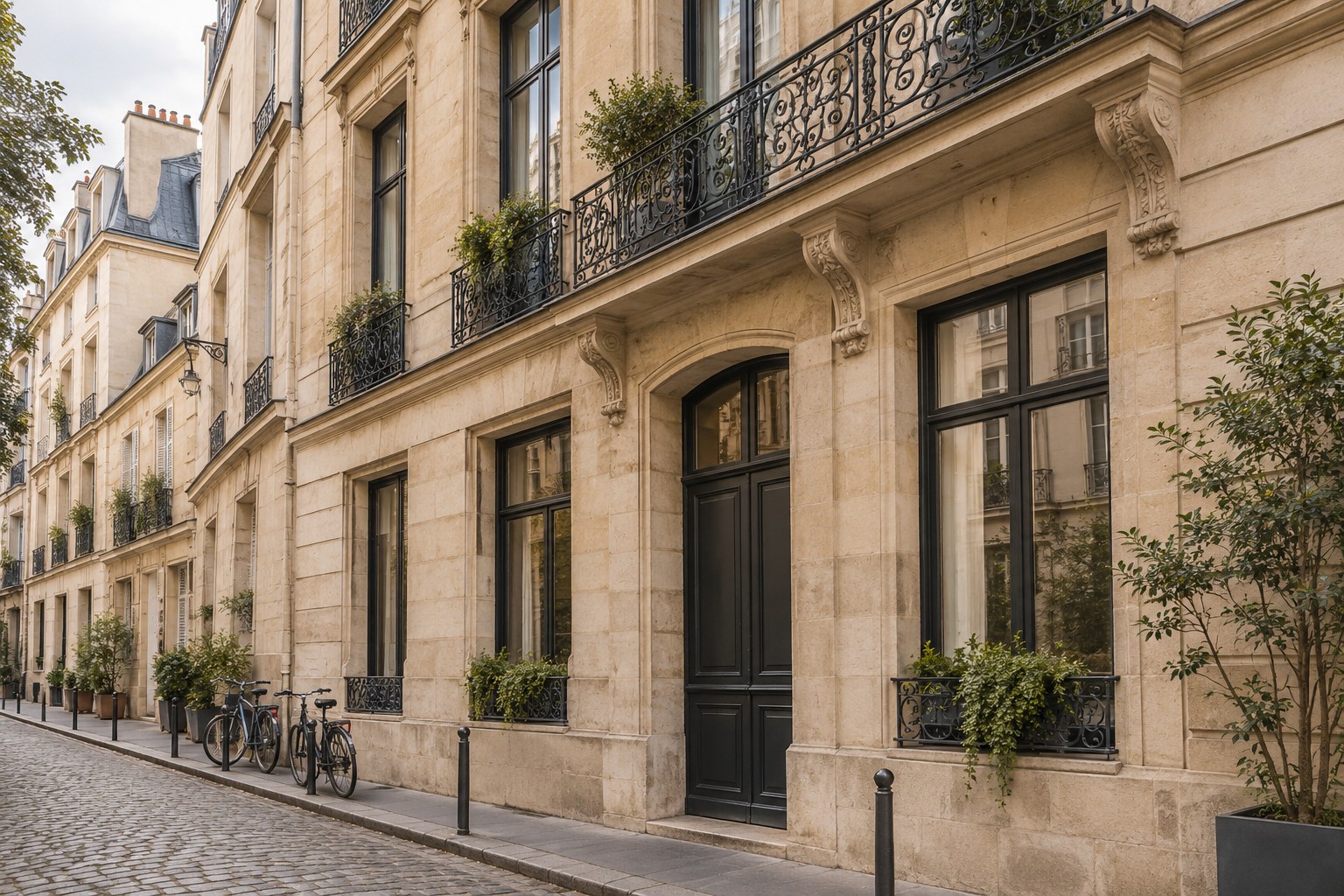
In Paris, it applies in particular to: changes to a building's external appearance (façade restoration, replacing or altering windows, changing the roofing, creating or altering a shopfront); the creation of between 5 and 20 m² of floor area, for example by converting an existing volume; a change of use of a premises without altering the façade or structure, for example turning a shop into housing; changes to the unbuilt areas around a building (courtyard, garden) when they lie within a remarkable heritage site or in the vicinity of a historic monument; and the installation of equipment visible from outside: blinds, shutters, air conditioners.
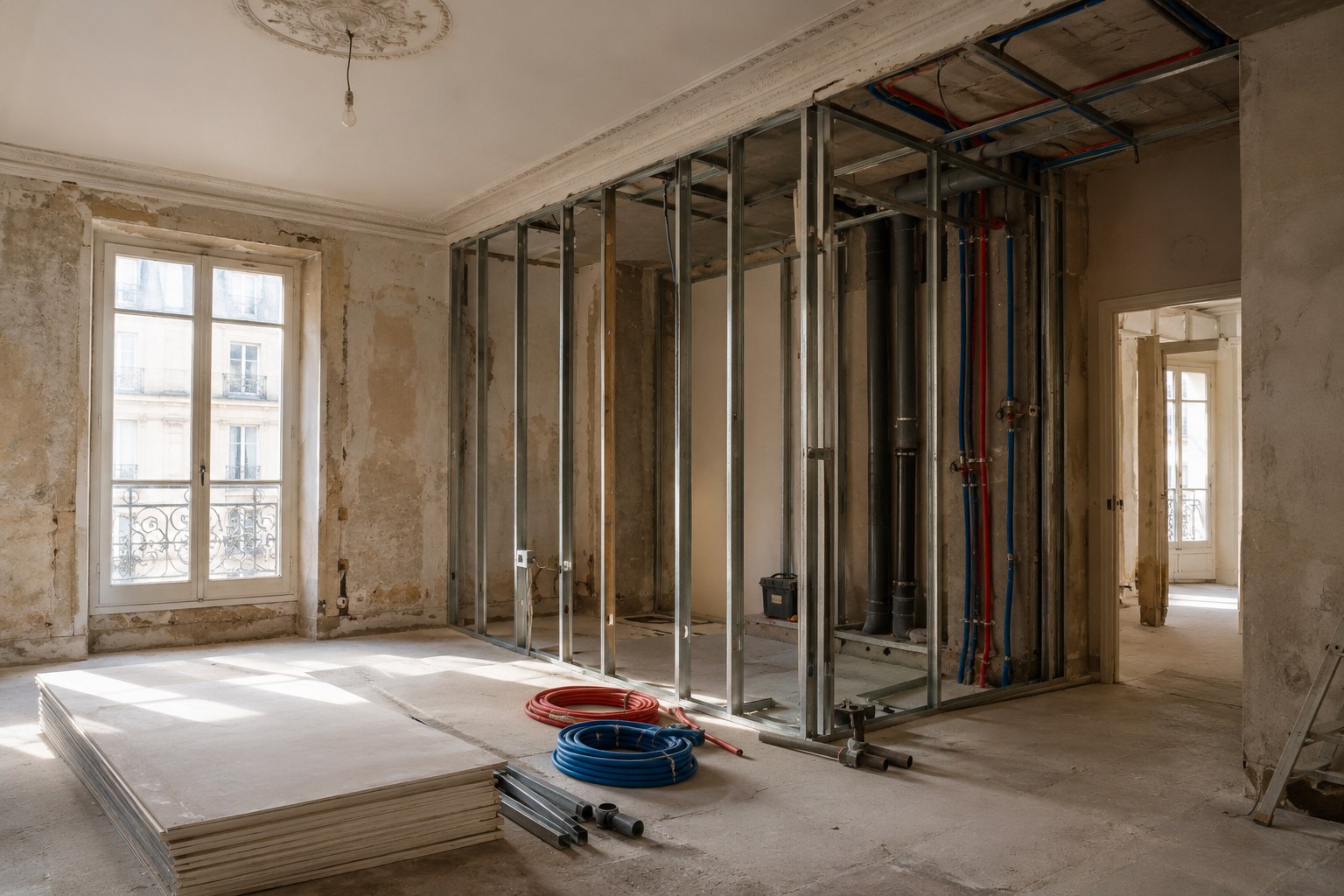
Conversely, a purely interior renovation (electrics, plumbing, finishes, non-load-bearing partitions, kitchen, bathroom) generally requires no prior declaration. This is good news for most apartments, with two major reservations detailed below: change of use and certain protected districts.
Beyond 20 m² of floor area created, or as soon as a change of use comes with a change to the façade or load-bearing structure, you move to a building permit, with a longer review. These thresholds are indicative: the exact nature of your project and the local rules can alter them, which is why it is worth having them checked before filing.
Paris is not a uniform territory
This is the point most often underestimated. The same works are not reviewed in the same way depending on the address, because several layers of rules overlap.
The bioclimatic PLU (the local urban plan) sets the general rules applicable across the capital: façade appearance, heights, materials, protection of certain elements of the built heritage. It can be consulted address by address, and is the first document to examine.
The vicinity of historic monuments forms a second layer. As soon as a building stands near a listed or registered monument, the opinion of the Architecte des Bâtiments de France (ABF) is required on works visible from outside. In Paris this situation is so common that the City itself states that reviewing a prior declaration often takes two months, precisely because the ABF is consulted.
Remarkable heritage sites form the most protective level. They cover two areas in Paris, which follow their own rules.
The Marais and the 7th arrondissement: rules of their own
The Marais (3rd and 4th arrondissements, around 126 hectares) is one of the first protected areas in France, created in 1964. The 7th arrondissement also has a remarkable heritage site of around 194 hectares, covering most of the eastern part of the arrondissement and extending as far as Les Invalides. Within these two perimeters, the PLU no longer applies; a safeguarding and enhancement plan (PSMV) does, a specific regulation whose aim is to protect the heritage and avoid any irreversible damage, while still allowing buildings to evolve.
In practice, this changes several things:
Planning authorisations are subject to the ABF's approval, which may attach requirements: choice of a material, a joinery profile, a colour, a construction detail. Without his approval, the authorisation cannot be issued.
The scope of works concerned is wider. Replacing a window, working in a courtyard, altering an architectural or decorative element is subject to authorisation.
Interior works may be concerned. In the Marais and the 7th arrondissement, interior works that alter a protected element (staircase, panelling, decorative features, structure of a notable building) may require authorisation. You should therefore not assume that an interior project is free of any procedure in these districts: it has to be checked building by building.
One positive point: the ABF can be consulted very early, on a preliminary design, before any filing. This is the method we favour, as it avoids discovering a reservation on a file already submitted.
Timelines: allow plenty of time
The schedule of a prior declaration breaks down as follows:
Within one month of filing, the authority sends a letter specifying the applicable review period and, where relevant, the list of missing documents. An incomplete file costs time, as the review only really starts once the file is complete.
One month is the standard review period for a prior declaration.
Two months when the ABF is consulted, that is, in the vicinity of historic monuments and in remarkable heritage sites. The ABF itself has one month to give its opinion on a prior declaration.
In Paris, most files therefore fall under the two-month period. In practice, we advise allowing two to three months between launching the file and starting the works concerned, including preparing the drawings, filing, any request for further documents, and display of the notice.
A few useful rules: the authorisation must be displayed on site, visible from the public highway, for the duration of the works; in the case of tacit authorisation (no reply within the period), it is advisable to request a certificate from the reviewing department; and at the end of the project, a declaration certifying completion and compliance of the works must be submitted.
The file: what it contains
A prior declaration consists of the Cerfa form corresponding to your project, accompanied by drawings and descriptive documents. The usual items are: the site location plan; the site plan, when the project alters the exterior; the plans and façades of the existing building and of the project, which clearly show what changes; a representation of the exterior appearance after works, by sketch or photomontage; photographs situating the project in its near and distant surroundings; and a notice describing the materials, colours and technical choices.
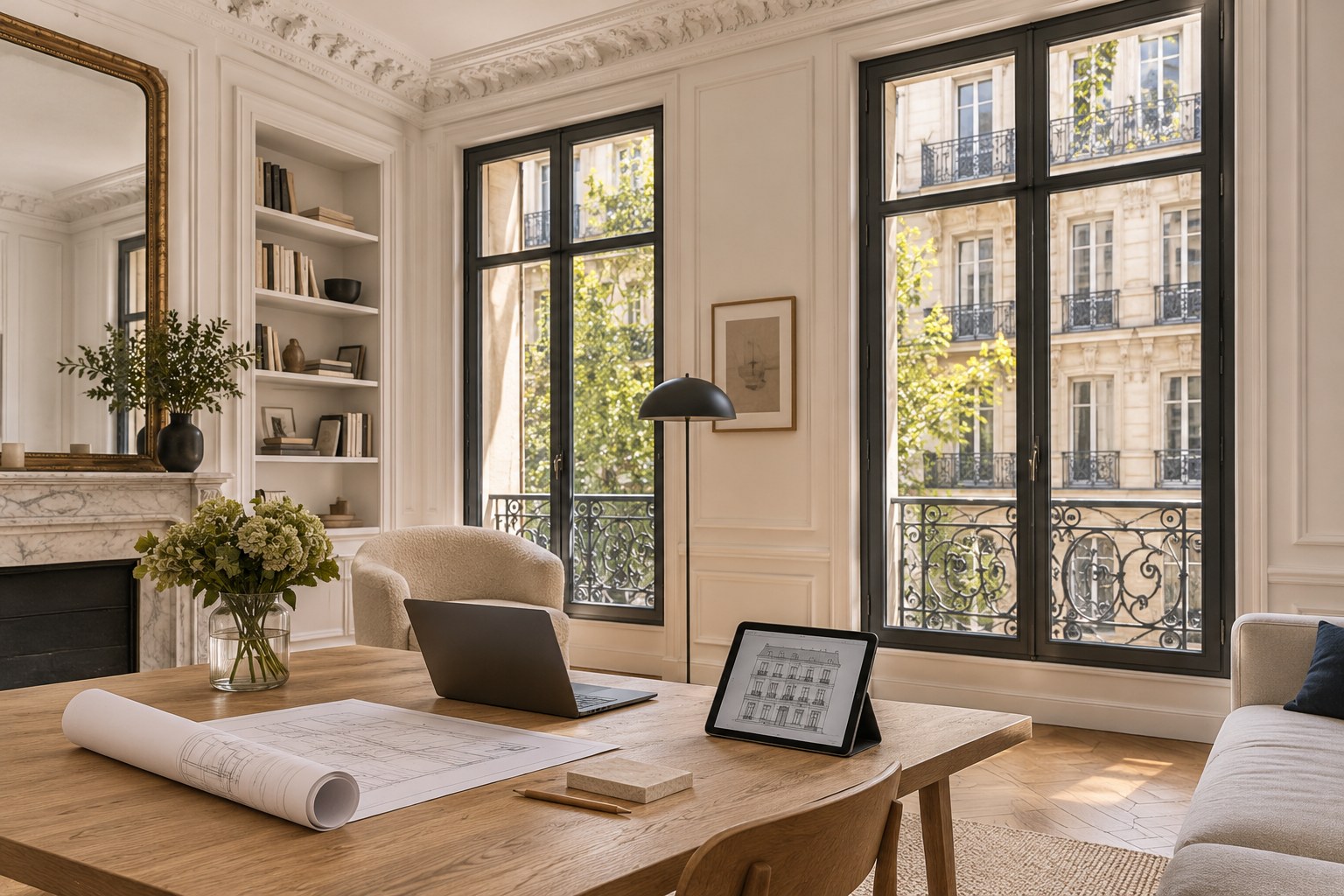
Depending on the nature of the works (façade restoration, change of use, shopfront, blind), the City of Paris provides sheets specifying the documents expected. For façade restoration or external insulation works, a dedicated sheet exists.
As for filing, it is done online through the City's e-service. It is mandatory for legal entities (co-ownerships, companies) since 7 April 2025; individuals may still file on paper.
Mistakes that cost time
We keep encountering the same pitfalls:
Starting works before the decision. Even for a like-for-like window replacement, starting without authorisation exposes you to a stop-work order and a costly compliance process.
Forgetting the co-ownership. Planning authorisation does not replace the co-ownership's agreement: any change to the façade or common parts generally goes through a general meeting. It therefore has to be factored into the schedule.
Choosing joinery without checking the district's rules. In a protected site, a window model outside the requirements leads to refusal or requests for changes.
Filing too thin a file. A blurred drawing or an incomplete notice triggers a request for documents, and each round trip lengthens the timeline.
Discovering the heritage constraint mid-project, when it should have guided the design from day one.
Our support
At Supra Studio, we build planning procedures into the design from the start, not afterwards. When a project in Paris requires a prior declaration, we take charge of the whole process:
The feasibility check: reading the rules applicable at the address (PLU, vicinity of monuments, heritage site), identifying the authorisation needed and the ABF's constraints, before any commitment.
Design adapted to the regulatory framework: materials, colours, joinery profiles and compositional choices designed to be accepted while respecting your project.
Putting the file together: form, plans of the existing building and of the project, façades, photomontages, photographs and notice.
Filing and following the review: dealings with the reviewing department, replies to requests for documents and, if needed, dialogue with the ABF.
Follow-up until the end of the works: display, consistency of the site with the authorisation obtained and declaration of completion.
Our role is to turn a procedure often seen as an obstacle into a controlled stage, whose timetable is built into the project schedule.
Planning works in Paris and wondering whether an authorisation is needed? Book an appointment for an on-site consultation, or get in touch to discuss it. To place these procedures within an overall project, our articles on the cost of renovating an apartment in Paris and on turning a two-room into a three-room apartment will give you further benchmarks.
The information in this article is indicative and reflects the rules in force at the date of publication. Each project must be checked with the City of Paris planning department.
Frequently asked questions
Do you need a prior declaration to replace your windows in Paris? Yes, in most cases, as replacing windows changes the building's outward appearance. In a protected site or near a historic monument, the ABF may impose requirements on the model, materials and colour.
Does an interior renovation require authorisation in Paris? Generally not, where it changes neither the exterior appearance nor the use of the premises. The notable exception is the Marais and the 7th arrondissement, where interior works affecting a protected element may require authorisation. A check address by address is essential.
How long does it take to obtain a prior declaration in Paris? The standard period is one month, but it rises to two months when the ABF is consulted, which is very common in Paris. Counting the preparation of the file, it is prudent to allow two to three months before the works concerned begin.
Is an architect compulsory for a prior declaration? No, it is not compulsory for this type of procedure. It is, however, very useful for designing a project compatible with local rules, producing precise drawings and photomontages and dealing with the authorities.
What happens if you start works without authorisation? You risk a stop-work order, penalties and an obligation to restore the premises to compliance, which can cost far more than the procedure itself. It is always better to check before starting.